

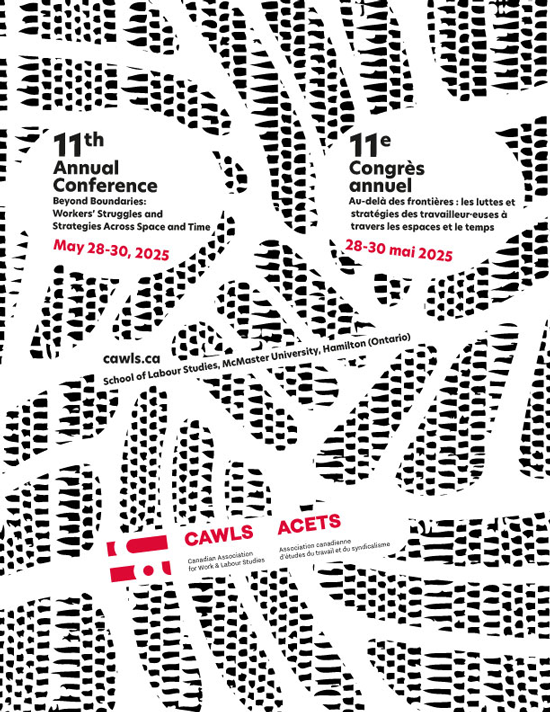
Beyond Boundaries: Workers’ Struggles and Strategies Across Space and Time
School of Labour Studies, McMaster University
Hamilton, Ontario
May 28-30, 2025
contact: [email protected]
Conference Fees
| Permanent or full-time faculty or Union staff | Students and other community members | |
| CAWLS members | $150 | $0 |
| Non-members | $300 | $60 |
Notes
Membership and Registration: Accepted presenters must be members of CAWLS and registered for the conference by April 30, 2025 or risk being removed from the program. Non-members are welcome to attend the conference.
Conference Hotel Sheraton Hamilton

Group rate: $189+taxes / night (includes one parking space)
Must book by April 1, 2025 to secure the conference rate
Sorry, registration for the conference is now closed.
 The conference organizing committee invites submissions for participation in the 11th annual conference of the Canadian Association for Work and Labour Studies (CAWLS). We welcome proposals on all topics that focus on the past, present, and future of work and labour studies. Our goal is to create a conference program reflective of the broadest range of methodological, theoretical, and disciplinary themes and approaches. The committee welcomes proposals for single papers, thematic streams, multiple-paper panels, roundtables, and workshops. The participation of researchers in union and community settings is encouraged.
How workers navigate, negotiate and contest changes in their lives—at work, at home, and in the community—over time and space is both a longstanding and contemporary concern in labour studies. Time and space are relevant at both the level of lived experience and of large-scale economic and political processes. The individual Uber driver is trying to spend the least amount of time on the road for the highest pay. A working-class family is trying to stretch their pay cheque to last to the end of the month. The migrant worker is navigating the push and pull across national borders to find work that will make a different future possible. At the same time, platform algorithms distribute work over space to extract as much value from each moment of time. Capital creates instant access to global markets to make itself immune to place-based organizing. Ideas of right-wing populism, xenophobia and racism spread globally like wildfire in ways that resonate with earlier decades. Capital expands through the “annihilation of space by time,” as Marx argued in the Grundrisse and geographers such as Doreen Massey and David Harvey built upon, but so too do labour and social movements have their own temporal and spatial strategies of resistance that spread in their own ways. The 2025 CAWLS conference is an opportunity to explore these dynamics and share ideas about the interplay between work and capitalism through time and space.
Questions relevant to these conversations include: How are the contemporary conditions of global capitalism transforming the spaces and times of work? How does capital use time and space to undercut workers’ power and solidarity? How do different forms of capitalism (neoliberal, social democratic, platform, racial or otherwise) shape workers’ struggles and strategies? How can workers build power and solidarity both locally and globally? How is the global spread of right-wing populism transforming the spatial and temporal dimensions of work and the dynamics and challenges of labour organizing? What can/does organizing look like for workers without a spatially defined “workplace”? How do anti/decolonial movements, anti-racist movements or uprisings, and labour struggles as represented in the union movement interrelate? How can anti-colonial struggles, such as the Land Back movement, be understood as struggles over the conditions and form of social reproduction? What lessons can be derived about the importance of the workplace as a site of struggle through the upsurge of political mobilization primarily oriented towards ‘the streets’ or the public sphere? How does the spatial division between much paid and unpaid work shape how we understand social reproduction and value women’s labour? In what ways are the spatial strategies of capital and labour new to the contemporary moment? How do they compare historically with previous moments of economic and political upheaval?
Participants are not required to limit themselves to the above list of questions. Other potential topics include but are not limited to:
- The crisis of gendered care work
- Queer critiques of the family as a site of capitalist social reproduction
- The relationship between student movements and labour movements
- Anti-Capitalist Anti-Racism: Intersectional and Decolonial Approaches to work and labour
- Workers’ struggles over pension funds and financialization
- Artificial Intelligence, Worker Surveillance, and Digital Colonialism
- Imperialism, Colonialism, and Labour Internationalism
- Work and mobility: Accessibility, disability justice, workers’ health and safety
- Gender issues in current and historical work and labour spaces
- Work, workers and culture: Cultural labour and “working-class culture” in the era of right-wing populism
Keynote Speaker
 Dr. Veena Dubal, Professor of Law, UC Irvine School of Law
Professor Veena Dubal’s research focuses broadly on law, technology, and precarious workers, combining legal and empirical analysis to explore issues of labor and inequality. Her work encompasses a range of topics, including the impact of digital technologies and emerging legal frameworks on workers’ lives, the interplay between law, work, and identity, and the role of law and lawyers in solidarity movements. Professor Dubal has written numerous articles in top law and social science journals and publishes essays in the popular press. Her research has been cited internationally in legal decisions, including by the California Supreme Court, and her research and commentary are regularly featured in media outlets, including The New York Times, The Washington Post, The Wall Street Journal, The Los Angeles Times, NPR, CNN, etc. TechCrunch has called Prof. Dubal an “unlikely star in the tech world,” and her expertise is frequently sought by regulatory bodies, legislators, judges, workers, and unions in the U.S. and Europe.

